Tip #20: Understand Sleep Mechanics
- How to Wake Up Early
- Tips , Sleep
- February 2, 2026
We always have a better chance to succeed in things which we understand and where we know underlying principles and laws, as opposed to things we do not understand. Let’s see how understanding sleep mechanics can help you sleep better and wake up earlier.
The principles of how sleep works are quite simple (well, at a basic level), yet many people have never heard about them. Here is your 5-minute crash course on sleep mechanics.
Sleep Cycles
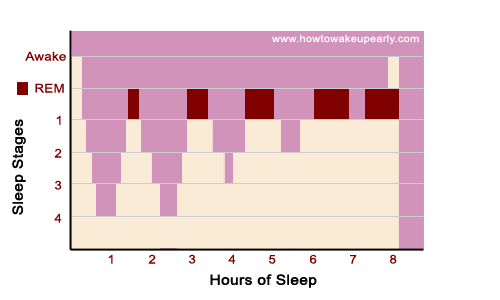
Sleep occurs in cycles of around 90-110 minutes each. Most people normally go through 5 cycles during the night (7.5-8.5 hours). If you sleep for 6 hours you’re likely to be on a 4-cycle diet.
Each cycle includes 5 different stages occurring in a particular order.
The 5 Stages of Sleep
Stage 1 – Drowsy sleep. This is the transition period from wakefulness to sleep where you drift in and out of sleep and can be awakened easily. Your eyes move slowly and muscle activity slows. You start losing conscious awareness of the external environment. It’s at this stage when you occasionally may experience sudden twitches and hypnic jerks from the sensation of falling or striking (don’t worry, these are normal).
Stage 2 – Light sleep. At this stage your body is relaxed and prepares to enter deep sleep. Stage 2 usually lasts longer than other stages – you spend 45-50% of your sleep in Stage 2.
Stages 3 and 4 – Deep sleep. Deep sleep is characterized by maximum brain and muscle relaxation, with Stage 4 being effectively a deeper version of Stage 3. Stage 3 is when you may experience night terrors, sleepwalking, and sleep-talking. People who wake during deep sleep often feel groggy and disoriented for several minutes. In deep sleep, there is no eye movement or muscle activity and the body is still. You usually go less deep each cycle, so most of your deep, Stage 4 sleep occurs in the first half of the night.
Stage 5 – REM sleep. REM stands for Rapid Eye Movement. This stage is very different from all other stages because in REM sleep, brain wave activity is similar to an awakened state. At this stage the body experiences periodic eyelid fluttering, muscle paralysis, and irregular breathing. Your heart rate increases and blood pressure rises. This results in intense dreaming, which occurs mostly during the REM sleep stage.
The end of the REM stage is an ideal time for waking up.
How Stages Form a Cycle
Stages go in the following order to form a full cycle: 1-2-3-4-3-2-1-REM
Duration of each stage may vary from 5 to 15 minutes. The REM stage lasts for 10 minutes ending the first cycle, with each recurring REM stage increasing in duration, and the final one lasting an hour. A total cycle ends up taking around 90-110 minutes. First cycles are usually shorter (closer to 90 minutes).
Important Notes
Drugs such as alcohol and sleeping pills can suppress certain stages of sleep. Even though you’ll sleep longer, such sleep may not fulfill its physiological functions completely.
Polyphasic sleep, which is a popular discussion topic, is an attempt to sleep for just 1 cycle in which you jump directly to the REM stage, thus sleeping for only 20-30 minutes and then staying awake for 3-4 hours, then sleeping for another 30 minutes, etc. This way you can cut down sleeping time to a total of just 3-4 hours per day. While some people have reported success in adapting to polyphasic sleep, the results and experiences are quite controversial. You definitely need to research polyphasic sleep in detail before giving it a try.
Key Takeaways
As you can see, nature has put quite a sophisticated mechanism in us. Now that you know this mechanism, the following conclusions seem obvious:
- The best time to wake up is at the end of a cycle. This is why going to bed and waking up at the same time every day is so powerful — your body learns to align with its natural cycles. You should pay more attention to your state when you wake up to try and identify what stage you are awakening from.
- If your alarm wakes you up interrupting your dream, very likely you’re in a REM stage or Stage 1, which is a good time to wake up.
- If you feel extremely disoriented when trying to wake up, then you’re waking up from Stages 3 or 4, which is the wrong time to wake up. Take another 30 minutes of sleep.
- Write down how long you sleep each day and try to adjust your sleep duration so you wake up at the end of a cycle. This can be done by paying closer attention to your state and your feelings at wake up time.
- Experiment slowly – you can’t change your sleeping pattern in one day, but you can do it easily over time with small steps. Sleep mechanics has a purpose behind it, don’t try to break it in one night.
Sweet Dreams!
Recommended Reading
- Sleep: What It Is, Why It’s Important, Stages, REM & NREM — Cleveland Clinic
- How Sleep Works: Understanding the Science of Sleep — Sleep Foundation
- Sleep — Wikipedia