Tip #32: Create an Evening Ritual
- How to Wake Up Early
- Tips , Sleep
- February 20, 2026
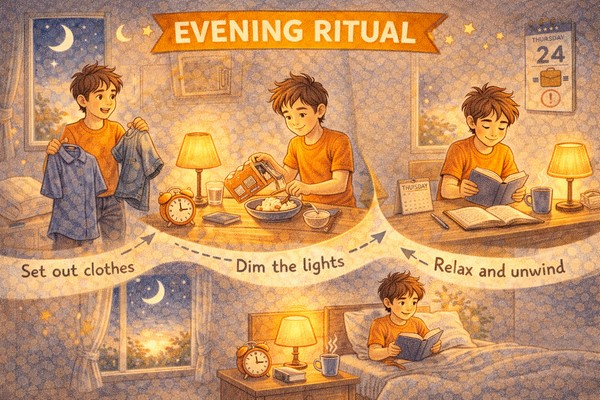
We talk a lot about what to do in the morning. But the truth is, your morning starts the night before.
If you want to wake up early without feeling terrible, look at what happens in the hours before you go to sleep. A proper wind-down routine makes falling asleep faster and waking up easier. Skip it, and even eight hours of sleep may leave you feeling unrested.
I touched on this idea in Tip #16, where Robin Sharma talks about the importance of the ten minutes before sleep. This tip takes that idea further — not just the last ten minutes, but the last five hours.
Why Winding Down Matters
Your body doesn’t have an off switch. It needs time to slow down. As you wind down, your body temperature drops, your heart rate slows, and your brain begins producing melatonin — the hormone that makes you feel sleepy.
If you skip this process, you’re trying to fall asleep while your body is still in full gear. You might eventually drift off, but the quality of your sleep suffers — and so does your ability to wake up early.
The 5-Hour Wind-Down
Here is one simple rule for each of the five hours before your target bedtime. If you want to be asleep by 10 PM, start at 5 PM.
5 hours before bed — Cut the caffeine. Caffeine has a half-life of around five hours, so that 3 PM coffee is still half-active in your system at midnight. Switch to water or herbal tea. Tip #13 explains the science in more detail.
4 hours before bed — No more intense exercise. Exercise improves sleep overall, but a hard session too close to bedtime raises your core body temperature and floods your system with adrenaline — both enemies of sleep. A gentle evening walk is fine. A full workout is not.
3 hours before bed — Stop eating heavy meals. Your digestive system keeps working when you eat late, and that activity interferes with restful sleep. As Tip #9 explains, a light snack is fine, but a full meal this close to bed is not a good idea.
2 hours before bed — Put the screens away. The blue light from phones, tablets, and laptops suppresses melatonin production and signals to your brain that it’s still daytime. But it’s not just the light — it’s the stimulation. Social media, news, and notifications keep your mind active when it should be winding down. Put the devices in another room if you have to.
1 hour before bed — Do nothing stimulating. This last hour is yours. No work tasks, no difficult conversations, no planning tomorrow. Read a physical book. Stretch gently. Listen to calm music. Let your thoughts settle.
One Rule at a Time
You don’t need to do all five at once. Start with the easiest one — probably the caffeine cutoff — and make it automatic. Then add the next. This is the same gradual approach recommended in Tip #25: small steps, steady progress.
Just as a morning ritual programs your body to start the day on autopilot, an evening ritual programs it to end the day well. The secret to a good morning is a good evening.
Recommended Reading
- Sleep Hygiene — Sleep Foundation
- Blue Light Has a Dark Side — Harvard Health Publishing
- Healthy Sleep — National Heart, Lung, and Blood Institute